| Start date: | 19 March 2026, 09:00 (CET) | Entry level: | Basic | |
| End date: | 19 March 2026, 12:30 (CET) | Subject area: | Artificial Intelligence (AI) | |
| Location: | ONLINE (Zoom) | Topics: | Large Language Models (LLMs) | |
| Language: | English | Target audience: | Industry, public admin, academia | |
| Price: | Free (for eligible participants) | Organizers: | AI:AT & ASC |
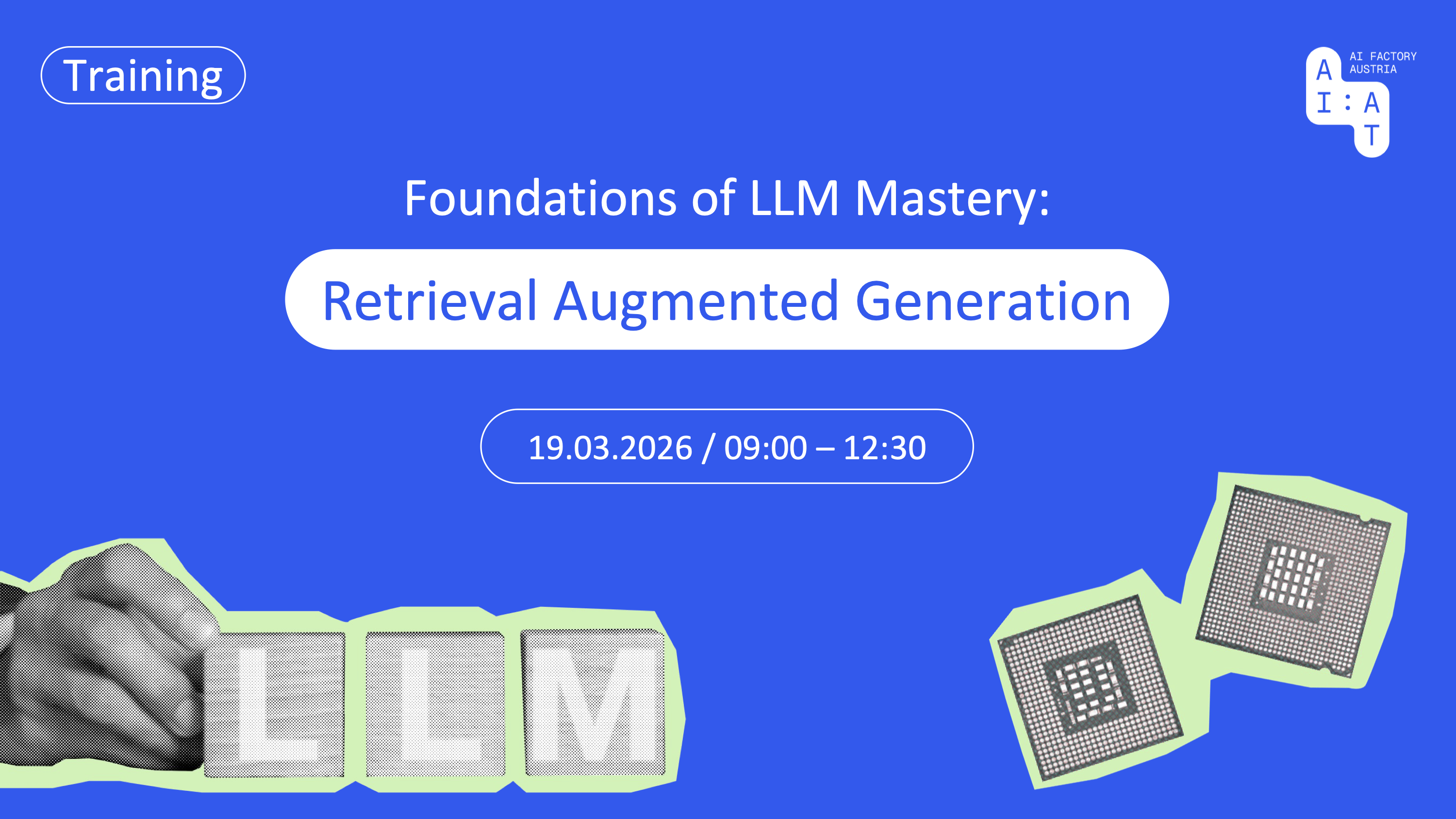
This course teaches you how to architect Retrieval Augmented Generation (RAG) pipelines, create knowledge bases, and optimize retrieval for highly accurate, context-aware applications. You learn to build AI systems that don't just generate text, but actively retrieve relevant data.
Retrieval Augmented Generation (RAG) is transforming the way language models provide contextually rich, accurate responses by integrating external knowledge retrieval. This 3.5-hour course offers an in-depth exploration of RAG techniques to enhance Large Language Models (LLMs) with real-time, relevant information.
Course topics include:
- Designing RAG-Enabled Systems: Learn to architect systems that seamlessly integrate retrieval and generation.
- Creating Knowledge Bases for RAG Applications: Create indexing pipelines to build and optimize knowledge sources for high-quality retrieval.
- Contextual Response Generation: Generate responses that draw directly from relevant knowledge to improve accuracy and coherence.
- Naive and Advanced RAG Techniques: Explore the evolution from basic to sophisticated RAG methods.
- Evaluating RAG Models: Measure RAG system performance to refine response quality.
Through practical examples and exercises, participants will gain hands-on experience in building RAG-powered applications, equipping them with the skills to deliver robust, context-aware LLM solutions for their projects.
By the end of this course, participants will have developed a foundational understanding of RAG techniques from the basics on to advanced and modularized approaches, enabling them to build their own, innovative applications.
Agenda & Content
For a detailed timetable and additional information, please see Agenda & Content in the left menu.
Target audience, eligibility & prices
This course is designed for software developers, data scientists, and researchers who want to transition from simply using AI tools to building, customizing, and deploying them.
This course is open and free of charge for all participants from academia, industry, and public administration from EU and/or EuroHPC JU member countries.
Entry level & prerequisites
Basic – no previous experience with RAG is required.
Participants are expected to be familiar with the Python programming language.
Course format
This course will be delivered as a LIVE ONLINE COURSE (using Zoom).
Hands-on labs
All participants will get a temporary user account on the LEONARDO supercomputer to do the hands-on labs.
You will use your own laptop or workstation to connect conveniently from your browser to a Jupyterlab session on LEONARDO to do the hands-on exercises.
Lecturer
Thomas Haschka (Campus IT / HPC, TU Wien)
Dr. Thomas Haschka is an Austrian biophysicist and computational scientist specializing in molecular biophysics, high-performance computing, machine learning and Artificial Intelligence. He currently works as an AI Specialist in the dataLAB of the High-Performance Computing Unit at Campus IT, TU Wien, supporting advanced research infrastructure and data-driven innovation. With a PhD from Université de Reims Champagne-Ardenne (highest distinction), he has held research positions at institutions such as the Pasteur Institute, Paris Brain Institute, and the American University of Beirut. His work spans molecular dynamics, epidemiological modeling, genomics, and AI evaluation methods, supported by strong expertise in GPU programming and cloud technologies. He combines academic research excellence with real-world industrial consulting experience.
Language
English
Date, time, and location
19.03.2026, 09:00 – 12:30 (CET), LIVE ONLINE COURSE (Zoom)
Registration
Registration is required, the registration form can be found on top of this page in the menu on the left.
Please register with your official institutional email address to prove your affiliation.
You will get an automatic confirmation by email (subject starting with "[Indico] Registration"), please check your Spam/Junk folders.
Following your successful registration, you will receive further information a few days before the course.
Please do not hesitate to contact us at training@ai-at.eu if you have any questions.
Waitinglist
After the number of registrations has reached its maximum or the registration form has been closed, you may want to send us an email (training@ai-at.eu) stating that you are interested to be put on the waiting list (vacancies may occur due to cancelations, etc.).
To be able to do the hands-on labs on the ASC systems please provide your full international mobile-phone number for the two-factor authentication required to login to the ASC systems.
Modification, withdrawal & no-show policy
Your registration is binding. Please only register for the course if you are really going to attend.
You can update your registration data or withdraw your registration anytime before the registration form has been closed via the link "Manage my registration" which you can find at the bottom of your automatic email confirmation (subject starting with "[Indico] Registration").
Alternatively, or after the registration form has been closed, please inform us about your cancelation or any change in your registration data (especially your mobile-phone number) via email (training@ai-at.eu).
No-show policy: If you do not cancel and do not show up at the course you will be blacklisted and excluded from future training events.
Organizers
This course is jointly organized by AI Factory Austria AI:AT and Austrian Scientific Computing ASC (aka ASC Research Center, TU Wien).
Acknowledgements
AI Factory Austria AI:AT has received funding from the European High-Performance Computing Joint Undertaking (JU) under grant agreement No 101253078. The JU receives support from the Horizon Europe Programm of the European Union and Austria (BMIMI / FFG).