Date: | 09 November 2026, 09:00 – 12:00 | Price: | Free (for eligible participants) | |
Format: | AI:AT Webinar, ONLINE (Zoom) | Target audience: | Industry, public admin, academia | |
Language: | English | Organizer: | AI:AT |
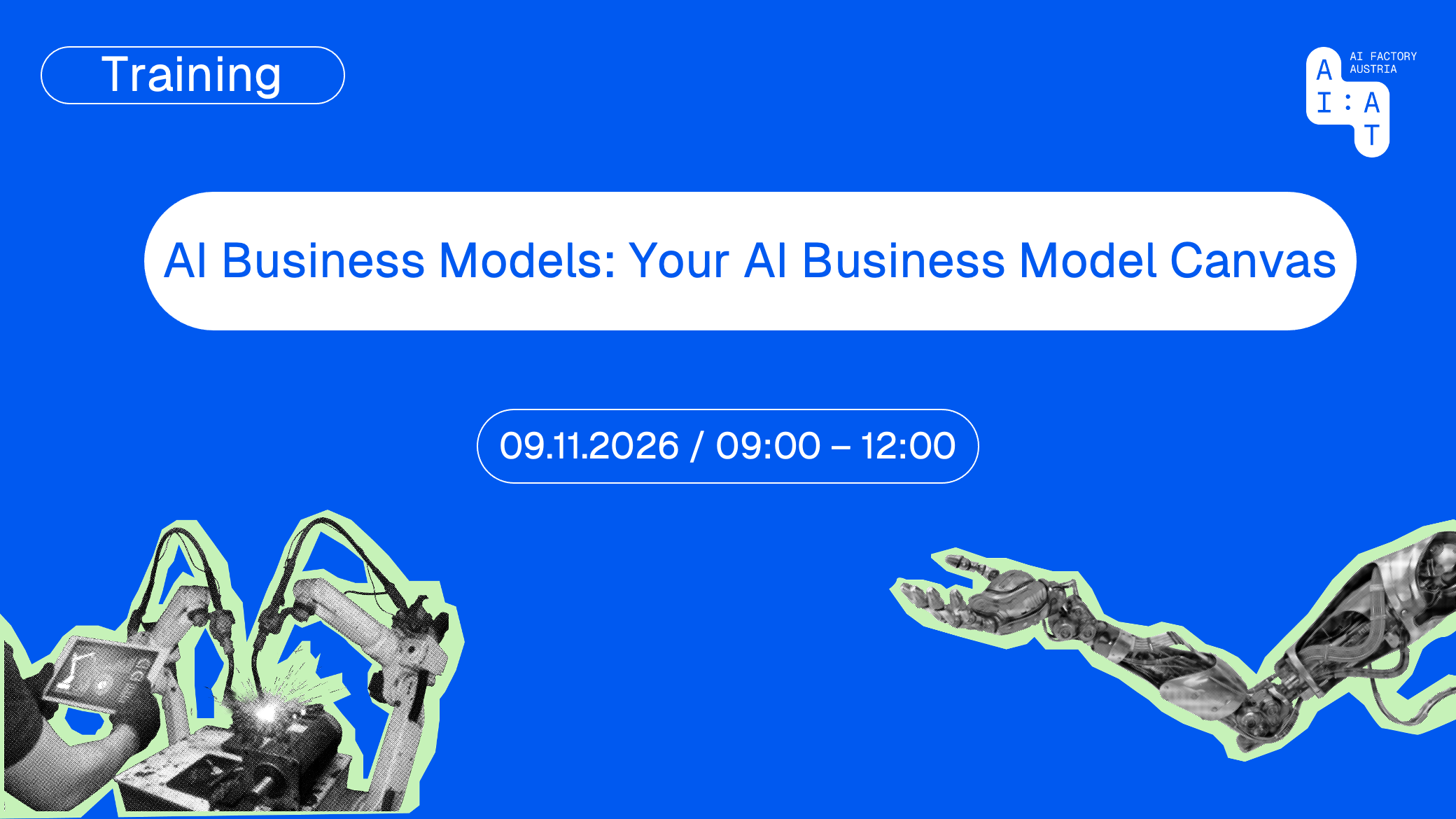
Most AI ventures don't fail on technology. They fail because the advantage they were built on disappeared with the next model release.
Some parts of an AI business model work differently, the rest follow familiar startup logic. Confusing the two is the expensive mistake. Using the Lean Canvas, we look at the four blocks that tend to hold and the five that tend to break: unfair advantage, cost structure, revenue streams, customer segments, channels, each through real cases.
Three questions to take into any AI venture:
- What stays defensible when the next model ships?
- What do our costs grow with?
- Which budget pays us?
In part two, participants build a Lean Canvas for their own project, stress-test the five critical blocks, and position the venture in the AI value chain. You leave with a canvas ready for investor conversations.
Target audience
The workshop is aimed specifically at startups, spin-offs and teams preparing a founding or wanting to test an idea. Everyone who wants to understand what makes an AI business model hold or break is also welcome. The workshop is particularly relevant for founders, investors, funding bodies, technology transfer offices, and strategy and innovation functions.
This webinar is open and free of charge for all participants from academia, industry, and public administration from EU and/or EuroHPC JU member countries
Entry level & prerequisites
Participants should be ready to work on a concrete venture idea and bring a venture or idea they are working on (a worked example is provided for those without one).
Agenda
Part 1
09:00: Welcome & Presentation of AI Factory Austria AI:AT
09:05 AI Business Models: Four Blocks Hold, Five Break
09:50 Questions & Discussion
Part 2
10:15 Building your Lean Canvas
11:00 Stress-testing the five critical blocks
11:35 Positioning in the AI value chain, plenary discussion
12:00 End
Speakers
Kathrin Heiss, PhD (Institute of Strategic Management, Johannes Kepler University Linz)
Kathrin Heiss is a Postdoctoral Researcher at the Institute of Strategic Management at JKU Linz. Her research covers strategic human capital and new forms of digital and decentralized organizing. She worked in strategy consulting at BCG before returning to academia.
Language
English
Date, time, and location
09.11.2026, 09:00 – 12:00 (CET), LIVE ONLINE WEBINAR (Zoom)
Registration
Registration is required, the link to the registration form can be found on the top of this page in the menu on the left. Please register with your official institutional email address to prove your affiliation.
You will get the Zoom link in the automatic confirmation by email (subject starting with "[Indico] Registration"), please check your Spam/Junk folders). We will also send 1–2 reminders before the webinar.
Please do not hesitate to contact us at training@ai-at.eu if you have any questions.
Modification, withdrawal & no-show policy
Your registration is binding. Please only register for the course if you are really going to attend.
You can update your registration data or withdraw your registration anytime before the registration form has been closed via the link "Manage my registration" which you can find at the bottom of your automatic email confirmation (subject starting with "[Indico] Registration").
Alternatively, or after the registration form has been closed, please inform us about your cancelation or any change in your registration data (especially your mobile-phone number) via email (training@ai-at.eu).
No-show policy: If you do not cancel and do not show up at the course you will be blacklisted and excluded from future training events.
Organizers
This webinar is organized by AI Factory Austria AI:AT.
Acknowledgements
AI Factory Austria AI:AT has received funding from the European High-Performance Computing Joint Undertaking (JU) under grant agreement No 101253078. The JU receives support from the Horizon Europe Programm of the European Union and Austria (BMIMI / FFG).